


Inversions look intimidating on paper — in practice, they’re one of the easiest ways to sound instantly more advanced.
When considering advanced inversions, it’s important that one remember that do you, are you, and will you are also inversions. However, those are not the ones we will approach today. There are four types of inversions in total.
Inversion is one of those grammar topics that seems unusual at first, but it becomes much easier once you understand why it exists. In English, we normally follow a subject-verb order, but in inversion that order changes for emphasis, style, or structure. It is especially common in advanced English, formal writing, and exam contexts.
There was a time, while preparing for the C2 Proficiency, when I became obsessed with inversions. Little did I know that they were just one of many elements that could refine my language production—or so I would say.
It is important to remember that inversion is not used just to sound “fancy.” It has specific functions. Sometimes it creates emphasis, sometimes it makes the sentence more formal, and sometimes it helps the sentence sound natural in English. If learners try to force inversion into every sentence, the result can sound awkward. The goal is not to overuse it, but to recognize when it is appropriate.
The simplest one is with negative adverbs or adverbial expressions. I deem them the simplest, as they tend to be the most readily noticeable and seamlessly integrated into speech and writing.
When to use inversions
1 Negative Adverbs
Negative adverbs such as never, seldom, rarely, hardly, and no sooner often trigger inversion. This type is probably the easiest to spot, especially in formal writing and in more advanced English. When these adverbs are placed at the beginning of the sentence, the auxiliary verb comes before the subject.

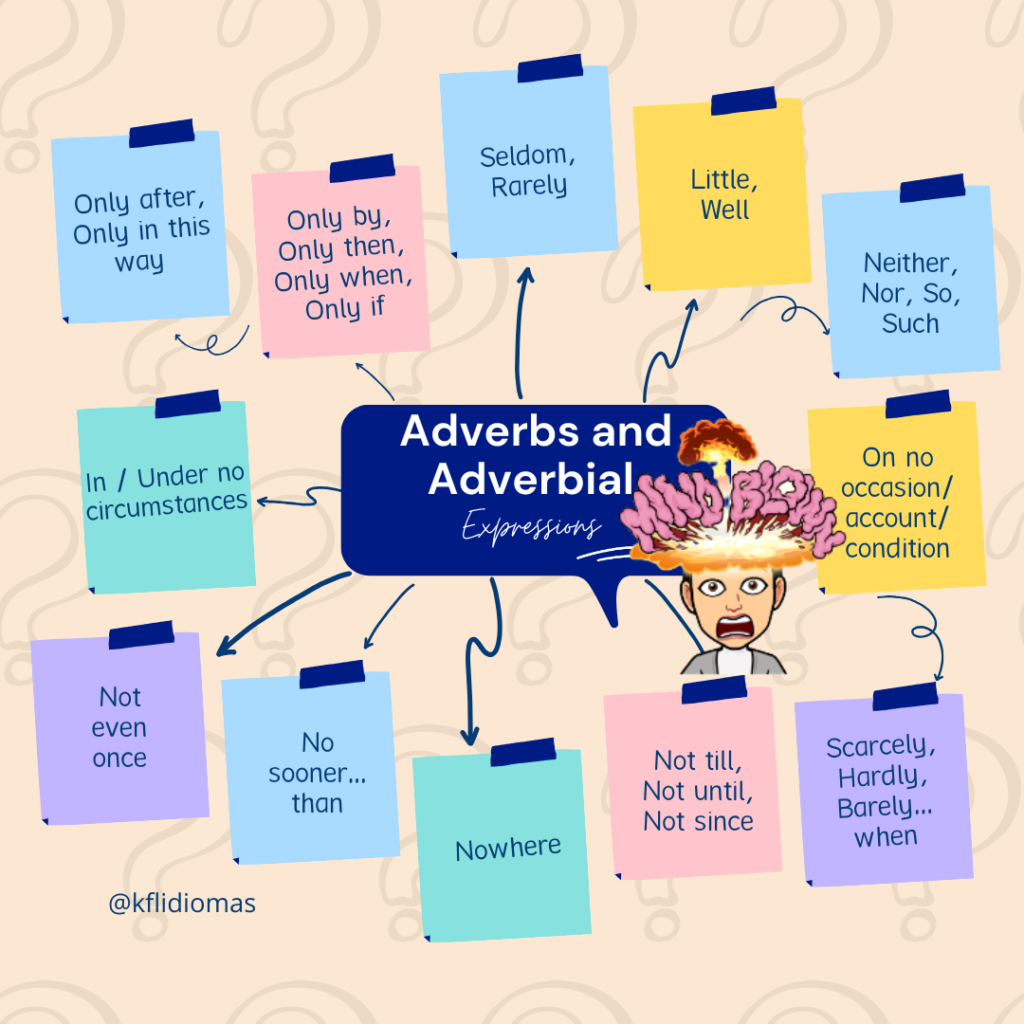
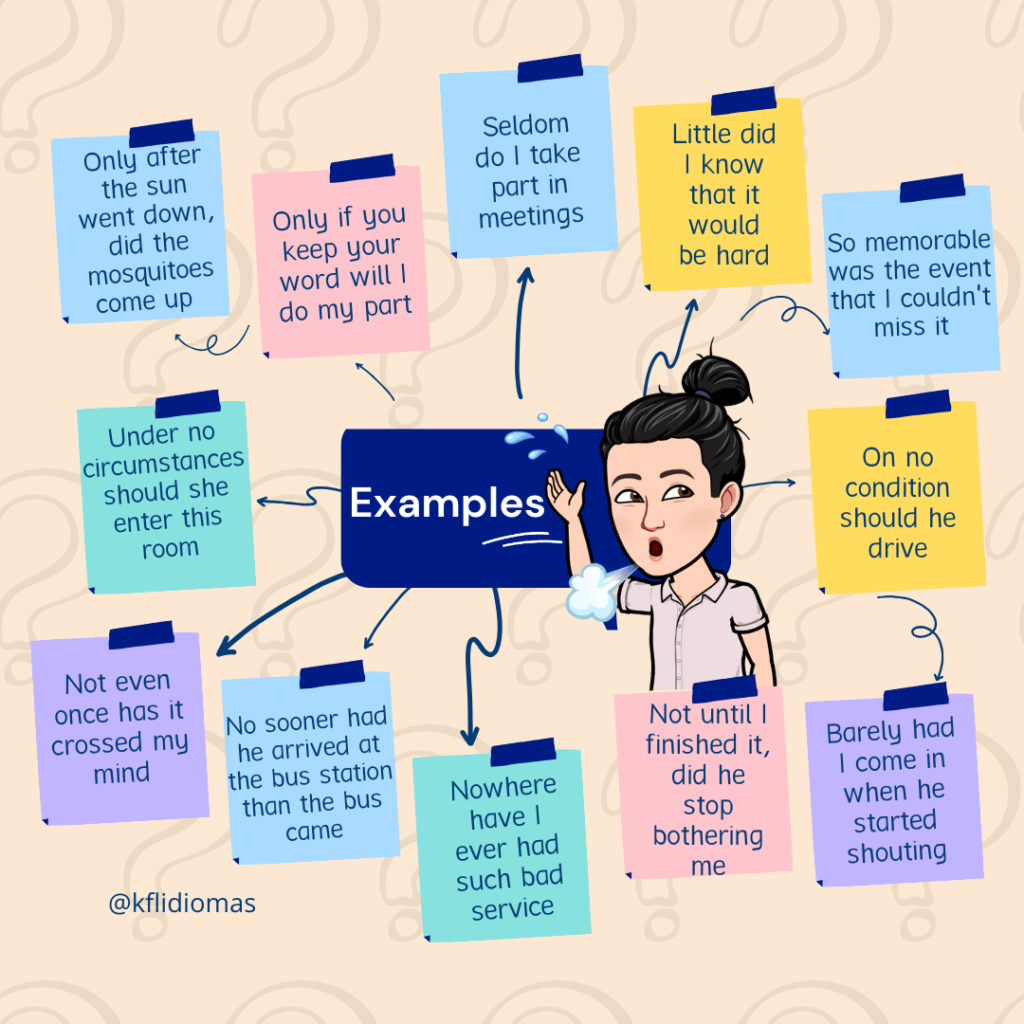
https://www.instagram.com/p/ChYFy4Khvo2/?igsh=ODM0MHEwZml6c3hh
2 If-clauses
The second type of inversion occurs in conditional sentences. In this video, we will focus on first-conditionals, though second- and third-conditionals also employ inversion in certain structures.
Instead of using if, English sometimes uses inversion for a more formal and elegant effect.
Take a look at the images to get to know them.


3 So and Such sentences
The third category involves inversions with so and such. Watch the video to understand it better and check examples.
4 Adverbs of place
The final type is triggered by adverbs of place. Even though it is a kind of inversion, grammarians usually call it fronting.
When an adverb of place (e.g., here, there, up, down, out, in, off, away) is placed at the beginning of a sentence, inversion often occurs when the verb is intransitive (i.e., it does not take an object). Examples:
Here comes the train.
(Normal order: The train comes here.)
There goes my chance of winning.
(Normal order: My chance of winning goes there.)
Out burst the children, laughing with excitement.
(Normal order: The children burst out, laughing with excitement.)
Down fell the apples from the tree.
(Normal order: The apples fell down from the tree.)
Away ran the thief before the police arrived.
(Normal order: The thief ran away before the police arrived.)
In walked the manager, looking furious.
(Normal order: The manager walked in, looking furious.)
Off flew the bird into the sky.
(Normal order: The bird flew off into the sky.)
Up went the balloon, disappearing into the clouds.
(Normal order: The balloon went up, disappearing into the clouds.)
Round the corner came a speeding car.
(Normal order: A speeding car came round the corner.)
Into the room rushed the paramedics.
(Normal order: The paramedics rushed into the room.)
In formal writing or literature, when a place adverbial starts the sentence, we add emphasis to it. This creates a more vivid and stylistic effect, which is why inversion is so common in narrative writing and more artistic texts.
Final thought
Inversions are not just a complicated grammar point. They are a way of adding emphasis, formality, and style to English. Once you start noticing them, you will see them in reading texts, formal writing, and even in speech.