


Prepositions rarely follow logic — they follow patterns, and patterns can be learned.
Learn the difference between “in the morning” and “on the morning”—a subtle preposition distinction that advanced English learners need to master for natural, precise English.

Why Prepositions Confuse English Learners
When we first start studying English, prepositions like in, on, and at feel like a thorn in the side. They don’t always translate neatly from our native language, which makes them tricky. Over time, with enough exposure, things get easier and start falling into place.
But even many years later, when you’re an advanced learner and basic prepositions are no longer a challenge, you may still stumble across subtle uses that make you pause. And that’s actually a good thing — it means you’re noticing the fine details that push your English to the next level.
You’ve studied English for years. You know the rules, you read fluently, and you speak with confidence. So why do you sometimes pause over tiny words like prepositions? The truth is, even advanced learners encounter moments that make them question what they thought they knew. And that’s exactly where real progress happens. Today, we’re looking at one of those moments: the subtle but important difference between “in the morning” and “on the morning”—a distinction that separates good English from great English.
A Real Example: “On the Morning” in a Novel
Take this excerpt from a fantasy book called Heat of the Everflame: The Kindred’s Curse Saga by Penn Cole.
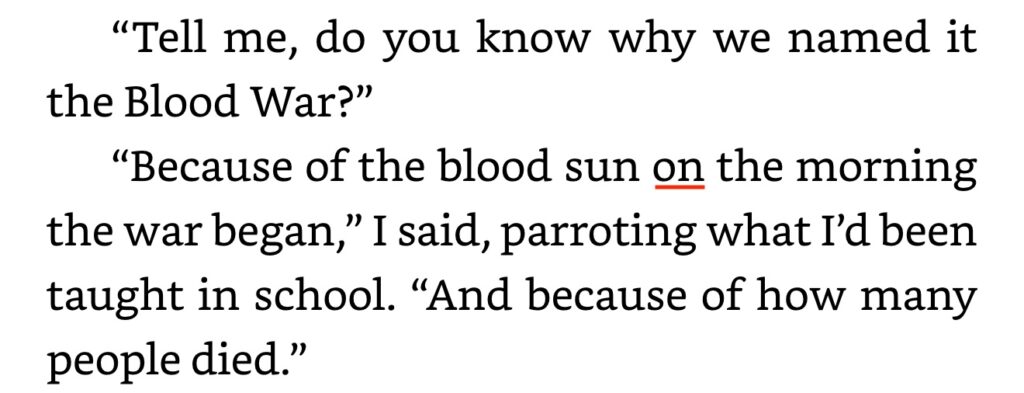
Immediately, you might recall your teacher’s advice:
“When you have periods of the day like morning, afternoon, and evening, we use in. So we say in the morning, in the afternoon, and in the evening.”
But why, then, does this American author use on the morning instead?
That kind of curiosity is exactly what advanced learners need to keep improving. And here’s the answer:
The Difference Between “In the Morning” and “On the Morning”
The subtle but important difference is all about specificity.
- In the morning → general time of day, not tied to a particular event.
- Example: I usually go jogging in the morning.
- Example: In the morning, I often take my dog for a walk before I go to work.
- Example: I usually go jogging in the morning.
- On the morning (of …) → one particular, identifiable morning, often linked to a date or historical event.
- Example: On the morning of July 4th, 1776, the Declaration of Independence was signed.
- Example: On the morning of my job interview, I was too nervous to eat breakfast.
- Example: On the morning of July 4th, 1776, the Declaration of Independence was signed.
If the author had written “in the morning the war began“, it would sound vaguer — just any time in the morning. By using on the morning, she marked it as a significant historical moment.
- “in the morning/afternoon/evening” = general period of the day.
- “on the morning/afternoon/evening of + date/event” = specific, often important moment.
- “I’m more productive in the morning.” (general habit)
- “On the morning of the exam, I woke up at 5 a.m.” (one special morning)
Tips for Advanced Learners
- Notice authentic use in English: books, films, and articles will show you how native speakers really choose prepositions.
- Pay attention to context: prepositions shift depending on how specific the time or event is.
- Keep asking “why”: this curiosity about small details sharpens your accuracy and helps you sound more natural.
Time to Practice
Ready to apply what you’ve learned? Take the quiz below to practice choosing between “in the morning” and “on the morning” in real sentences. You’ll see the answers right after you submit, so you can learn from any mistakes. Good Luck! And Stay Curious!
👉 Explore more: [Mastering Nuances in Advanced English]
👉 You might also like: [Master the most commonly confused words]
👉 Related read: [From Good to Great article]